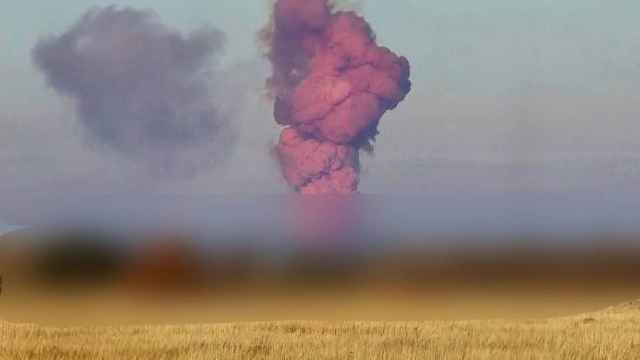

Recent events in Russia have raised alarm, particularly following the explosion of the newest nuclear missile, "Sarmat," at the Yasny military base in the Orenburg region. On Friday afternoon, witnesses captured footage showing the missile launching from its silo only to veer off course, ignite, and crash back to earth, resulting in a significant mushroom cloud of orange and violet hues. Experts suggest this catastrophic failure likely points to the "Sarmat," a missile Russia has been developing since 2013 to replace aging Soviet-era ground-launched missiles.
Initially, President Vladimir Putin promised that "Sarmat" would be operational in the military by 2020, a target that has clearly not been met. Approximately a year ago, a prior launch attempt also ended in disaster when a "Sarmat" exploded on a test site in Plesetsk, leaving behind a massive crater. The recent failure, which occurred just one kilometer from its launch point and created a 70-meter hole in the ground, has not gone unnoticed.
Military experts like Pavel Podvig and Étienne Marcuz concur that the repeated delays in certifying the missile could severely impact Russia’s strategic deterrence capabilities in the medium term. Overall, the SARMAT program faces more significant delays, raising concerns about the future of Russia’s nuclear arsenal.
With Russia’s strategic nuclear forces comprising 333 ground-launched missiles and various other platforms, the implications of these failed tests extend beyond technical failures, impacting geopolitical stability and military posturing in a tense global environment.